
Introduction The automotive industry is undergoing its most significant transformation since Henry Ford’s assembly line: the shift to electrification. While many manufacturers are producing electric vehicles (EVs), Ford Motor Company has taken a dual approach. By electrifying its most iconic nameplates—the Mustang (Mach-E) and the F-Series (F-150 Lightning)—Ford isn’t just targeting early adopters; they are targeting the heart of the American automotive market. However, the success of Ford’s “Model e” division hinges on more than just compelling vehicles; it requires solving the complex puzzles of battery supply chains, power grid integration, and widespread charging infrastructure.
The Power of Icons: Electrifying the F-150 and Mustang Ford’s strategy to electrify the F-150 and Mustang was a calculated gamble. By taking the F-150, America’s best-selling vehicle for over four decades, and making it electric, Ford immediately legitimized EVs for work and utility, not just commuting. The F-150 Lightning’s defining feature isn’t just its swift acceleration; it is its bidirectional charging capability (Intelligent Backup Power). This technology allows the truck to act as a home generator, providing power during outages—a feature that bridges the gap between automotive utility and home energy management. Similarly, the Mustang Mach-E successfully translated the brand’s performance heritage into a sleek, technologically advanced SUV, challenging dominant players in the EV space.
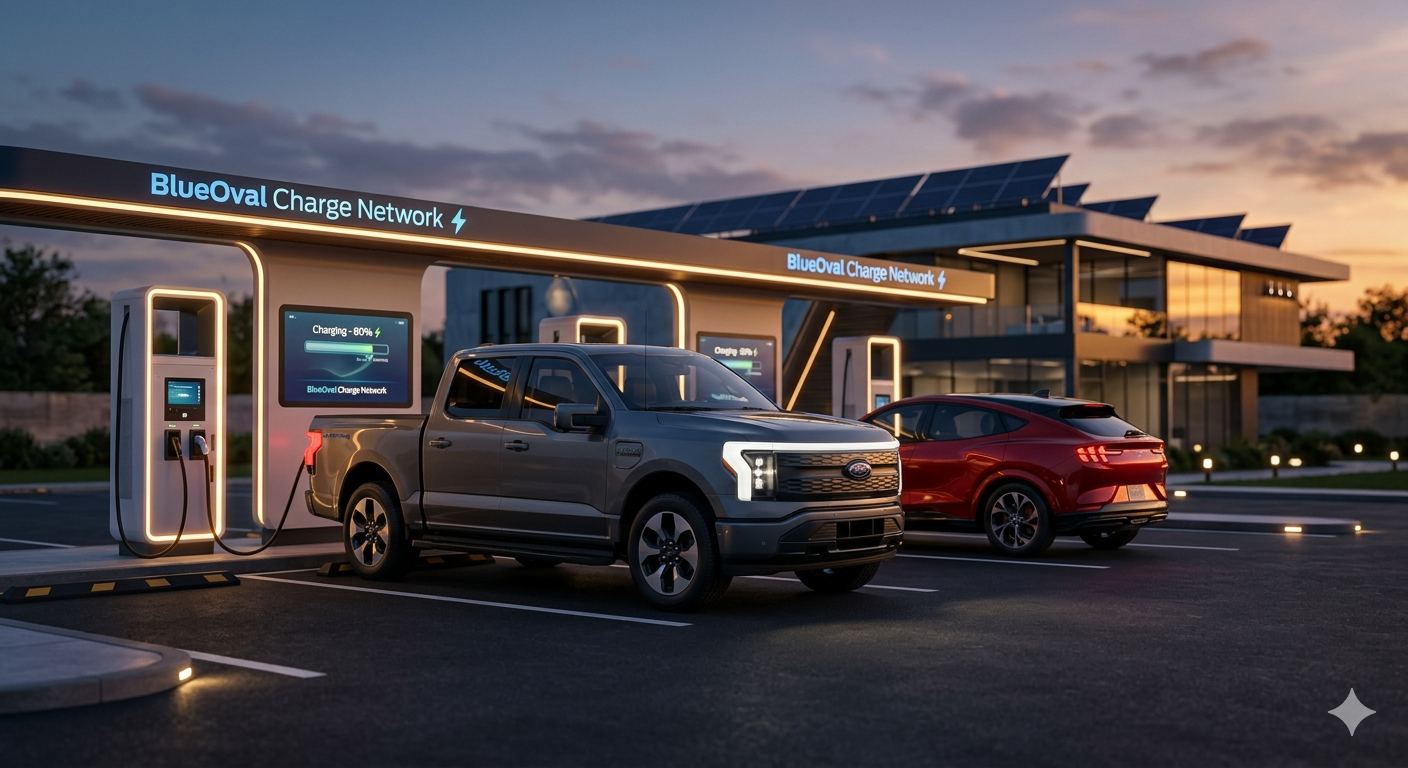
Overcoming the Infrastructure Hurdle: The BlueOval Charge Network The biggest barrier to EV adoption remains “range anxiety” and the perceived lack of charging availability. Ford’s answer is not to build a proprietary, closed network, but to create North America’s largest public charging network: the BlueOval™ Charge Network. This network is an aggregator, giving Ford drivers seamless access to over 106,000 public chargers from various providers, including Electrify America and, significantly, Tesla’s Supercharger network (via an adapter and future native NACS integration). This interoperability is crucial. By simplifying the payment and activation process through the FordPass app, Ford is reducing the friction of EV ownership and making long-distance travel viable for the average consumer.
The Financial Ecosystem of Ford EVs From a High CPC perspective, the EV conversation extends far beyond the vehicle itself. It triggers a cascade of high-value financial consumer actions:
-
Home Charging Installation: Every EV purchase necessitates a home charging solution. This drives leads for electricians, home automation companies, and manufacturers of Level 2 charging stations (like the Ford Connected Charge Station).
-
Solar and Energy Storage: Consumers purchasing F-150 Lightnings for backup power are often prime candidates for residential solar panels and battery storage systems (e.g., Tesla Powerwall or Sunrun integration), creating a lucrative crossover market.
-
Specialized EV Insurance: Insuring an EV involves different risk calculations (due to battery costs and repair complexities). This generates high-value inquiries for specialized auto insurance products.
Conclusion Ford’s EV strategy is not merely about selling cars; it is about building a comprehensive ecosystem that includes the vehicle, the home, and the energy grid. By addressing infrastructure roadblocks through strategic partnerships and leveraging its most powerful brands, Ford is positioning itself not just as a car car company, but as a leader in the broader energy transition.